
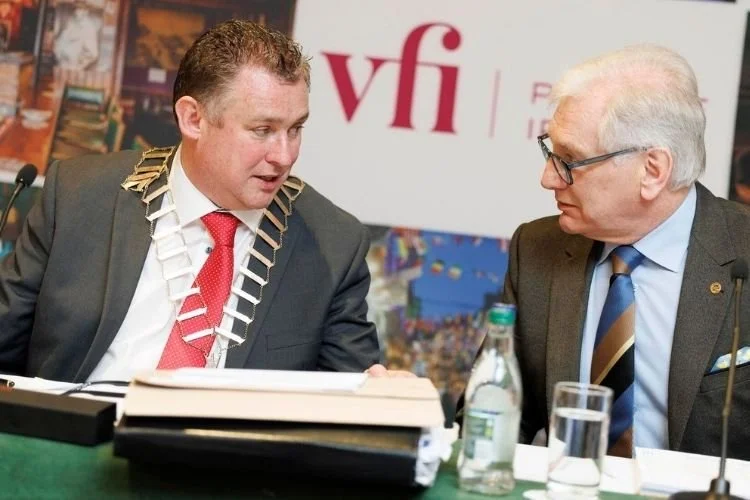
VFI President Michael O’Donovan & CEO Pat Crotty
Ireland's pub industry is under real pressure, and the Vintners' Federation of Ireland (VFI) is making sure Government hears about it.
Announced at the VFI AGM in May 2026, the organisation is calling on Government to introduce a new On-Trade Sustainability Scheme as part of Budget 2027. The proposal centres on a targeted tax credit for pubs, designed to ease the financial burden that has been piling up on publicans across the country.
What exactly is being proposed?
Under the scheme, pubs would receive a tax credit of €20 for every 50 litre keg of draught beer or cider sold, based on verified purchases from the previous year. The credit would be capped at €20,000 per pub per year and could be used to offset VAT, income tax or capital gains tax. For pubs with little or no tax liability, it could be claimed as a direct cash payment.
The scheme would be open to all licensed pubs, regardless of whether they serve food, and would apply to both sole traders and limited companies.
Why is this needed?
The VFI is pointing to a sustained rise in operating costs as the core problem. Energy bills, wage increases and general overheads have all climbed sharply in recent years, and many rural and smaller pubs do not qualify for existing supports like the reduced VAT rate on food. For those businesses, there has been very little in the way of targeted relief.
The Federation argues that pubs are not just businesses. They are community anchors, particularly in rural Ireland, where the local pub is often one of the last remaining gathering points in a town or village. When a pub closes, it is not just a commercial loss. It removes a space where people connect, where local events are held, and where older or more isolated members of a community might have their only regular social contact.
The proposed scheme is designed to protect that wider social value by directing support at the core of what a pub does, which is selling draught products. It is a focused intervention rather than a blanket subsidy, and that specificity is part of what makes it a credible ask.
The energy cost problem in hospitality
Of all the pressures bearing down on Irish pubs right now, energy is one of the most significant and one of the least talked about. Running a pub is an energy-intensive operation. Refrigeration units run around the clock. Cellar cooling systems need to maintain consistent temperatures. Heating and ventilation have to work harder in older buildings. Hot water demand is constant. Lighting across a large floor space adds up quickly.
For many pub owners, energy is now one of the top three costs in the business, sitting alongside wages and rent. The difference between those costs and energy is that wages and rent tend to be relatively fixed, while energy has a degree of variability that can be managed if you know where to look.
The problem is that most pubs have never had a structured look at their energy use. Bills arrive, they get paid, and the focus moves back to the day-to-day of running the business. That is completely understandable, but it means a lot of money is leaving the business unnecessarily every month.

The VFI is a vibrant National Trade Organisation for pubs outside the greater Dublin area.
Where the waste tends to happen
In a typical pub, the biggest areas of energy waste are refrigeration, heating controls and lighting. Older refrigeration units are often running inefficiently and could be replaced or serviced to bring consumption down significantly. Heating systems in pubs that were not built with energy efficiency in mind are frequently oversized or poorly controlled, heating areas that do not need it at the times they do not need it. LED lighting upgrades, while straightforward, are still not universal across the sector.
Beyond equipment, behaviour and monitoring matter too. Knowing what your energy consumption looks like in real time, and being able to spot anomalies when they appear, puts you in a much stronger position than waiting until the bill arrives to find out something has gone wrong.
What can pub owners do right now?
The VFI's campaign deserves support, and it is worth following the progress of the On-Trade Sustainability Scheme as Budget 2027 approaches. But waiting on policy is not a strategy for managing costs today.
An energy audit is a practical first step. It gives you a clear picture of where your energy is going, what is costing more than it should, and what changes would have the biggest impact. The good news is that for most pub owners, the cost of that audit does not have to come out of your own pocket.
If your business spends less than €10,000 on energy annually, a fully funded energy audit is available through your Local Enterprise Office. If your annual energy spend is above that threshold, the SEAI has support in place to cover the cost instead. Either way, there is a route to getting a professional assessment of your energy use without any upfront cost to the business.
It does not have to be complicated, and the findings are often more actionable than people expect. If you are unsure which scheme applies to you or want to understand what the process involves, the team at Watt Footprint is happy to walk you through it.
For more information, you can read about the Vintners Federation of Ireland here; https://vfipubs.ie/