
Two trends worth watching in Irish food manufacturing
Two Trends Shaping Irish Food Manufacturing
Irish food manufacturing has quietly become a lot more productive over the last five years. Then energy prices went back up.
Teagasc published its mid-year Situation and Outlook for Irish Agriculture on 20 July, and while it is written for farmers, the input cost picture in it reads across directly to anyone processing food in this country.
Productivity is heading the right way
Here is the more encouraging half of the picture.
Labour productivity in Irish food manufacturing has climbed steadily since 2021, from roughly $136,000 per worker to $216,500 in 2026. Statista projects it continuing upward to $244,600 by 2031.
That is not luck. It is a sector that has invested in automation, better process control and modernised plant, and it is now getting substantially more output from each person on the floor than it did five years ago.
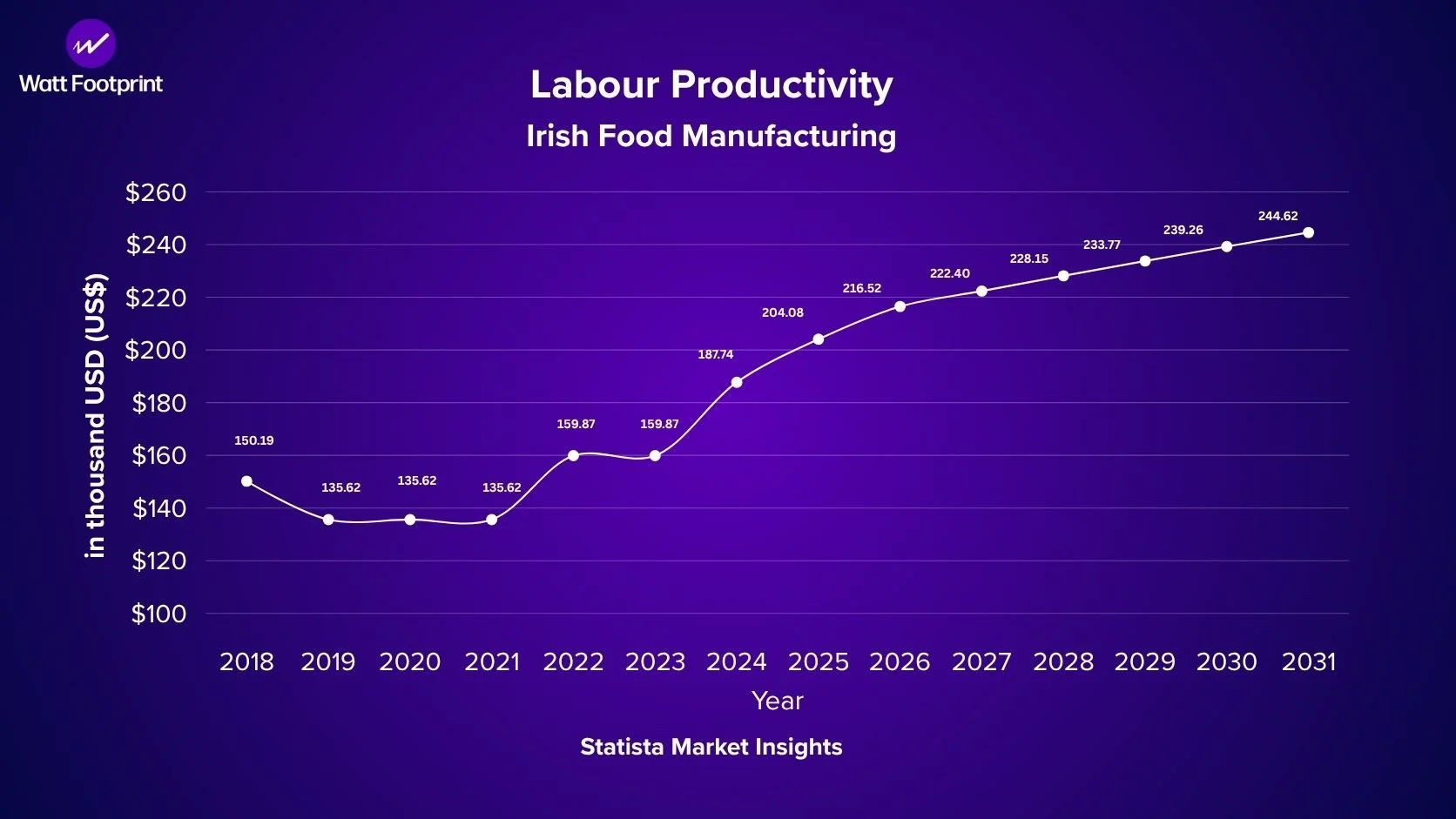
Irish Food Manufacturers are expected to see an increase in Labour Productivity
Energy is heading the wrong way again
The conflict in the Strait of Hormuz pushed crude oil to around $120 a barrel in the second quarter of 2026. It has since eased back to roughly $80, but that is still well above the sub-$60 level it sat at before the conflict began.
Teagasc forecasts a 20% increase in transport fuel expenditure across Irish agriculture this year, and around a 5% increase in electricity prices. Natural gas has risen too, which is what feeds through to both electricity and fertiliser.
In the pig sector, where Teagasc tracks costs in more detail, energy has already moved from 5.5 cent to 6.2 cent per kilogram, a rise of 13%. Non-feed costs overall are up 9.5% year on year and 24% since 2020.
None of that is within any operator's control. It is set in oil markets and geopolitics.
The gap between the two
Put those trends side by side and something obvious falls out.
Irish food manufacturers have got very good at measuring and improving output per worker. Productivity is tracked, targeted and managed. It gets reviewed weekly in most plants.
Energy rarely gets the same treatment. For a lot of sites, energy is a monthly bill rather than a metric. It arrives, it gets paid, and if it is higher than last month the explanation is usually a shrug and a reference to the market.
That is the gap. The discipline that lifted labour productivity by 60% in five years has simply not been pointed at energy in most operations.
What pointing it at energy looks like
It starts with visibility. In most food manufacturing sites, refrigeration, steam, compressed air and clean in place systems account for the bulk of consumption. Until those are metered separately, you are guessing about where the waste sits.
What tends to surface first is not a capital project. It is equipment running outside production hours, compressors leaking, refrigeration setpoints tighter than the product actually needs, and heating and cooling fighting each other in the same space. Those cost nothing to fix once you can see them.
The capital measures come after, and by then you know which ones are worth doing and roughly what they will return. That is a very different conversation to approve than a general proposal to spend money on efficiency.
The point
You cannot do anything about the price of a barrel of oil. You can do something about how many kilowatt hours it takes to produce a tonne of product.
The sector has already proved it can drive that kind of improvement. It has done it with labour. Energy is the same exercise with a different meter.
Watt Footprint works with Irish manufacturers on exactly this. Metering and monitoring to establish the baseline, an audit to identify the measures worth doing, grant funding to bring down the capital cost, and project management to deliver the work around your production schedule.
Get in touch and we will tell you where your site stands.