
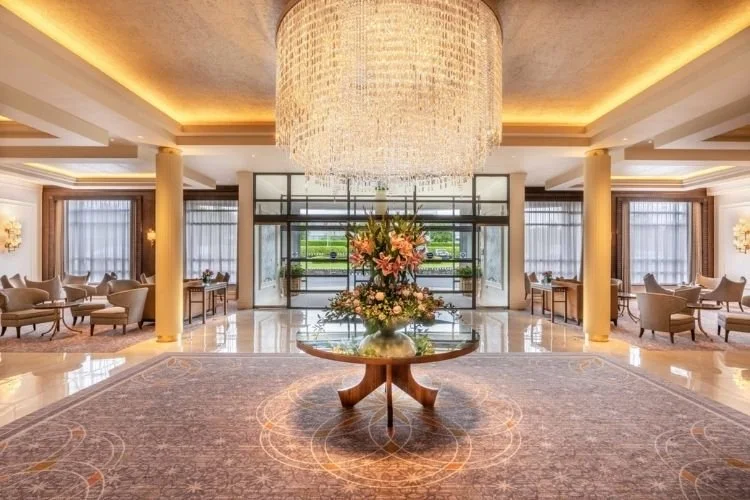
The Mullingar Park Hotel Lobby
There's a version of energy management that looks great on paper but doesn't translate into real, lasting results. Then there's the kind of work we get to do with clients like Mullingar Park Hotel, where the numbers speak for themselves and the results are independently verified.
We're proud to share that Mullingar Park Hotel's EXEED certified energy transformation has been published as a case study by SEAI. Here's what the project delivered:
665,905 kWh saved per year
138 tonnes of CO2 reduced per year
€88,776 in annual cost savings, a 10.8% cost reduction
33.9% total energy savings across the full energy journey with Watt Footprint
SEAI EXEED Designed certification with results independently verified by the NSAI
And the hotel is just getting started.
A Hotel That Took Energy Seriously Before It Was Easy
Mullingar Park Hotel is a family-owned, four-star destination hotel in Ireland's midlands. It's the kind of place that has a lot going on, a 20-metre swimming pool, sauna, steam room, gym, conference facilities, banqueting suites, and full spa and leisure services. Energy is not a small line item for a property like this.
What makes this project stand out is that the hotel's energy journey didn't start with an audit report sitting on a shelf. It started during COVID-19, when reduced occupancy should have meant reduced consumption. It didn't. That prompted the installation of comprehensive sub-metering, giving the hotel full visibility of where energy was actually going. That early commitment to understanding their energy use became the foundation for everything that followed.
What We Did Together
By the time the EXEED project began, Watt Footprint had already been working with Mullingar Park Hotel on energy management, utility optimisation, and heating system upgrades. A lot of the straightforward wins had already been captured.
That's where the SEAI EXEED (Excellence in Energy Efficient Design) programme, conducted in accordance with IS 399, came into its own. Rather than chasing individual quick fixes, the methodology pushed us to think about the whole system and how everything interacts.
The key measures included:
Ventilation and air conditioning upgrades across the function room, including chiller energy unit savers and air handling unit upgrades with variable speed drives
Swimming pool AHU ductwork insulation
Conference room lighting and CO2 demand-led control upgrades
Advanced Building Management System controls with real-time monitoring, fault detection, data trending, and remote performance analysis
Future-proofed BMS architecture, designed to integrate new assets and adapt as the business grows
Detailed energy modelling and measurement and verification (M&V)
Integrated design assessment to capture the interactions between systems
That last point matters more than people realise. When you treat systems in isolation, you miss savings. When you model how they interact, you find them.

Josephine Hughes, Owner, Mullingar Park Hotel
The Results
The EXEED project alone delivered additional savings of approximately 10.5% on top of what had already been achieved. But when you look at the full picture of the hotel's energy journey with Watt Footprint, the total energy savings stand at 33.9%.
These aren't projected figures. They are independently verified by the National Standards Authority of Ireland (NSAI) as part of the EXEED certification process. That matters, because verified savings are real savings.
As our Specialist Energy Manager Timmy McCarthy put it:
"With many of the readily identifiable opportunities already addressed, the EXEED IS 399 processes provided a structured framework to uncover more complex energy-saving measures and delivered additional savings of approximately 10.5%. These savings should be viewed as part of the hotel's wider energy efficiency journey, which has resulted in overall energy savings of 33.9% to date."
What EXEED Certification Actually Means
Achieving SEAI EXEED Designed certification is not just a badge. The process requires that energy savings be measurable, real, and sustained over time. It forces a design-led approach from the outset, rather than retrofitting efficiency thinking after decisions have already been made.
For Mullingar Park Hotel, it also means their sustainability credentials are independently backed, which is increasingly important for guests, corporate clients, and any ESG reporting requirements down the line.
As Josephine Hughes, Owner of Mullingar Park Hotel, put it:
"By taking a structured design-led approach to energy efficiency, we've delivered measurable savings and improved performance across the entire facility. It's a win for the business, our guests, and the environment."
What Comes Next
The hotel is not stopping here. They are exploring solar PV and battery storage, further electrification of building services, expanded smart energy management, and continued optimisation through data-driven operations. The BMS infrastructure put in place during this project is already built to support that roadmap.
Our CEO Paul Mahon summed it up well:
"Watt Footprint were proud to support Mullingar Park Hotel on their second EXEED project with us. A tremendous achievement by the Mullingar Park team, the impact and significant savings are clear to see. We look forward to the continued partnership.
Thinking About Your Own Energy Journey?
If you're running a hotel, a leisure facility, or any large commercial property, the Mullingar Park story is a good illustration of what a structured, long-term approach to energy management can actually deliver. It's not about one project. It's about building the right foundation, capturing savings systematically, and verifying that they stick.
If you'd like to explore what that could look like for your organisation, we'd be happy to talk.